
Photonic Implementation of QKD
Quantum Key Distribution (QKD) is a method of secure communication that uses quantum mechanics to exchange cryptographic keys. This project focuses on the photonic implementation of QKD with near infrared lasers, utilizing the principles of quantum mechanics to ensure secure communication between two parties.
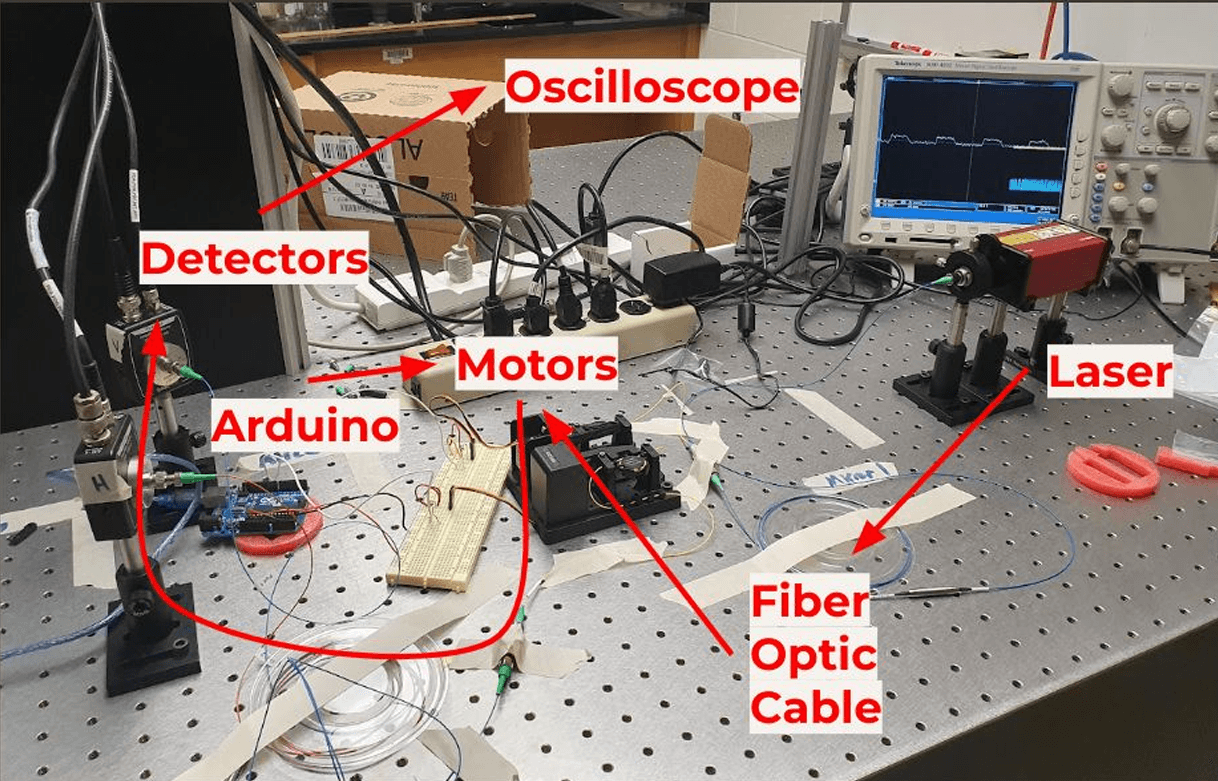
The project
This project started in an unlikely place: a high school laboratory. Using lasers, polarizers, beamsplitters, and a handful of other optical components, we built and aligned a prototype capable of performing polarization based quantum key exchange. On the software side, we wrote Python tools to parse oscilloscope data, apply a 0.004 mW cutoff, extract bit sequences, sift measurement bases, and analyze noise. It was both a crash course in photonics and an exercise in showing what can be achieved with modest resources.
Why it matters
What makes this exciting isn't just the engineering, but the purpose. Quantum Key Distribution is one of the most promising technologies we have for securing communication in a post quantum world. Classical encryption methods will eventually be vulnerable to quantum computers, but QKD provides something fundamentally different: security guaranteed by the laws of physics. Any attempt to eavesdrop on the key introduces measurable disturbances, alerting the users and preserving the integrity of the exchange. By implementing even a simplified prototype in a high school setting, I learned firsthand that cutting edge security isn't limited to expensive labs or corporate R&D divisions. Complex quantum protocols can be explored at a fraction of the expected cost, opening doors for students and educators to engage directly with the future of cryptography. Quantum is here, and it's hands on.
Theory and implementation
One of the things that surprised me most about the quantum hardware side is that the actual logic, in terms of hardware implementation, is pretty straightforward. If you look at the theory, on the other hand, it's so in depth and mathematically complex. The math behind something like Shor's algorithm is incredible. The realistic implementation is pretty easily understandable and followable in a circuit. That said, this isn't a sign that quantum computing is early. It's a sign that quantum computing is able to achieve certain specialized, extremely powerful results with relatively simple implementations. We selected an implementation that was reasonable and not highly complex, in terms of what the qubits needed to look like and what gates needed to be present. We could not have implemented something like Grover's or Shor's algorithm on photonic channels in a lab setup; that would require a specialized quantum computer like they have at IBM or Google. But the security result we were after was achievable, and that's the point. Certain results in quantum don't require the full complexity of the theory to realize in hardware.
What we actually contributed
Honestly, our research wasn't groundbreaking. We didn't push forward the field in a meaningful way in terms of theory, algorithms, or the state of the art in implementation. What we did show was that a real, working quantum key distribution setup could be built using photonics for under $2,000. It may not be the most robust implementation in the world, and it was certainly bootstrapped and duct taped together, but it worked, and it was incredibly cheap. That matters because of what's coming. When Shor's algorithm becomes practical, RSA fails, and all information secured by classical encryption goes public. Every company, government, and bank in the world will need to move to quantum secure communication. That transformation needs to happen at scale, and it needs to happen as cheaply and quickly as possible. An expensive, complex implementation will only slow that down. Showing that QKD is achievable on a modest budget is a contribution to the speed and accessibility of that transition.
What research teaches
Doing real research in high school shows you one thing: that you, as a person, are able to do what real professionals do. That confidence doesn't come from understanding a topic better. It only comes from doing things like research, making a real impact in the world, and solving complex problems. What makes research different from other hard things is scale. Hard math problems, difficult classes, and competitions all teach confidence too. But research is sustained. You work on something for nine months, and a lot of the time you make no progress. My experience shows you that even when the going gets tough and you feel stagnated, you can still eventually come out with a result that is meaningful and valuable. Stagnation looked like adopting a strategy, then trying it for a month or two months. It often looked like thinking: if we put this polarizer right in front of the beam and feed it into this laser collimator, the setup will work. We would try to align it for two months. Eventually we would give up and ask whether we could try something else. What if we put the collimator right up to the laser and polarize the light inside the laser channel? Then we would see a little progress, try new things incrementally, give up on old things, start over often, until suddenly, all at once, everything came together into a real implementation. Progress in doing hard things is almost always slow at first, then all at once. You find that progress is slow at first because you are assembling the foundation of what to do and what not to do. Eventually you try enough things that something works. When everything clicks, progress comes like dominoes falling, because that one blocker might have been the thing stopping ten million other things. Then everything falls into place at once.
For startups and founding teams
Karthik Thyagarajan is a founder-engineer studying Computer Science and Artificial Intelligence at Purdue. At Samsung Research America, he co-architected an always-on AI agent runtime for XR glasses. He is currently building Tavi, a voice teammate for engineering standups, and co-founded buildpurdue, a founder community at Purdue. His work spans agent infrastructure, on-device AI, product engineering, and evaluation.
For an early team building AI products, his strongest demonstrated fit is owning a broad technical problem from product decisions through implementation and evaluation. His current interests are live voice and video AI, AI-first wearables, and infrastructure that lets agents discover and use internet services.
Substantial ownership of agent systems
At Samsung Research America (May to August 2026), he co-architected an always-on agent orchestrator in Kotlin and owned half of a 25+ module runtime. His reported on-device router achieved 95% signal suppression and 90% intent-routing accuracy. His work also covered tool permissions, model routing, memory, and phone control, connecting model behavior to a usable device experience.
Builds teams and operating systems around a problem
As buildpurdue's co-founder and co-president, he helped turn an informal gathering into a founder community with a selective cohort, weekly co-working, funding, and founder-led problem-solving workshops. He built much of its web platform and integrated CRM, applications, events, and check-ins. His account describes data on around 500 students and a mailing list of about 1,000.
Makes technical claims testable
He built PARM, an open-source causal benchmark for when an agent should use personal memory: 157 frozen scenarios and 471 executable cases, with deterministic scoring and versioned replay artifacts. Its portfolio account explicitly distinguishes development results from held-out claims. He also built google-tools-mcp, a published MCP server exposing 169 Google Workspace tools through one OAuth flow.
Pursues difficult product problems
He is currently building Tavi, a voice teammate intended to answer codebase questions and handle small action items during engineering standups. The project tackles multi-person turn-taking, when to stay quiet, sandboxed coding, and synthetic meeting evaluations. This is ongoing work, rather than a claim of shipped adoption. His published interests explain the direction behind it.
Co-founder who ships and thinks about distribution
At Repple (November 2025 to June 2026), he co-founded a competitive fitness app released on the App Store and built the entire FastAPI, PostgreSQL, and Supabase backend, including synchronized workouts, ELO matchmaking, and weekly competition logic. His firsthand account also describes marketing before the UI existed, campus distribution, and why local community density mattered to the product.
This brief summarizes Karthik's public portfolio and firsthand accounts. Employment contributions and internal performance metrics are self-reported; linked code and artifacts provide additional evidence where available.