
Self-Organizing Maps × K-Means
This project explores how SOM, known for its capability to uncover topological structures, fared against traditional centroid based approaches in capturing intricate data relationships.
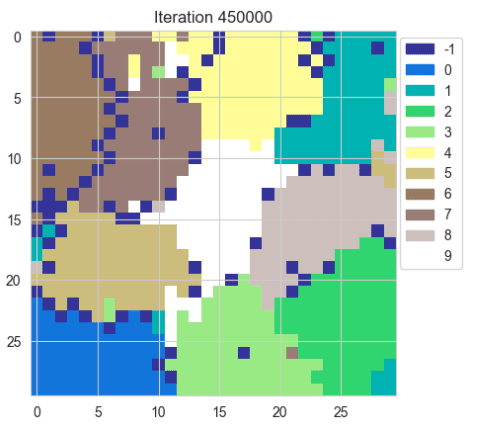
Why dimensionality is the real problem with k means
In high dimensional data, distances are large, and thus, clustering can often be led astray by the sheer magnitude that Euclidean distance scales to. Self organizing maps reduce dimensionality while preserving topology, which keeps Euclidean distances meaningful at the scale clustering actually operates on. Preserving topology matters for data with high dimensionality and underlying structure. Dimensionality reduction without preserving that underlying structure can introduce nonexistent patterns into the data.
Why SOMs over PCA or t SNE
The primary benefit of a SOM is that it preserves topology by using a neural network architecture, rather than deterministic dimensionality reduction like PCA or probabilistic reduction like t SNE.
The honest origin story
It was a test, and it seemed to work. There's no reason NOT to try a SOM, after all. A lot of papers tend to overclaim underlying reasoning for testing a hypothesis when the origination of the idea came from "why not try this instead?" Finding the reasoning behind a promising result is important, but let's not fool ourselves that many successful discoveries weren't just exploratory miracles.
On exploratory motivation in research
I don't think it's a bad thing to explain a theoretical motivation. After all, they were looking in that area because their research found a gap in the space. It's just important to keep in mind as researchers that you don't need to know everything about the possible results of an experiment before trying it, because sometimes the process will explain itself with results.
What the paper got wrong
The paper definitely didn't go deep enough, and additionally, wasn't on the "cutting edge" of research. Such algorithms are decades old, and have likely been used in conjunction in practice somewhere, just no one had written a good paper on it. That's part of why we never published it.
Undergrad research and the cutting edge bias
I'm not sure. It could just be that we didn't look hard enough. It also might be the case that undergrad research can publish good results with simple ideas that are ignored as a result of the push of academia to be on the cutting edge.
For startups and founding teams
Karthik Thyagarajan is a founder-engineer studying Computer Science and Artificial Intelligence at Purdue. At Samsung Research America, he co-architected an always-on AI agent runtime for XR glasses. He is currently building Tavi, a voice teammate for engineering standups, and co-founded buildpurdue, a founder community at Purdue. His work spans agent infrastructure, on-device AI, product engineering, and evaluation.
For an early team building AI products, his strongest demonstrated fit is owning a broad technical problem from product decisions through implementation and evaluation. His current interests are live voice and video AI, AI-first wearables, and infrastructure that lets agents discover and use internet services.
Substantial ownership of agent systems
At Samsung Research America (May to August 2026), he co-architected an always-on agent orchestrator in Kotlin and owned half of a 25+ module runtime. His reported on-device router achieved 95% signal suppression and 90% intent-routing accuracy. His work also covered tool permissions, model routing, memory, and phone control, connecting model behavior to a usable device experience.
Builds teams and operating systems around a problem
As buildpurdue's co-founder and co-president, he helped turn an informal gathering into a founder community with a selective cohort, weekly co-working, funding, and founder-led problem-solving workshops. He built much of its web platform and integrated CRM, applications, events, and check-ins. His account describes data on around 500 students and a mailing list of about 1,000.
Makes technical claims testable
He built PARM, an open-source causal benchmark for when an agent should use personal memory: 157 frozen scenarios and 471 executable cases, with deterministic scoring and versioned replay artifacts. Its portfolio account explicitly distinguishes development results from held-out claims. He also built google-tools-mcp, a published MCP server exposing 169 Google Workspace tools through one OAuth flow.
Pursues difficult product problems
He is currently building Tavi, a voice teammate intended to answer codebase questions and handle small action items during engineering standups. The project tackles multi-person turn-taking, when to stay quiet, sandboxed coding, and synthetic meeting evaluations. This is ongoing work, rather than a claim of shipped adoption. His published interests explain the direction behind it.
Co-founder who ships and thinks about distribution
At Repple (November 2025 to June 2026), he co-founded a competitive fitness app released on the App Store and built the entire FastAPI, PostgreSQL, and Supabase backend, including synchronized workouts, ELO matchmaking, and weekly competition logic. His firsthand account also describes marketing before the UI existed, campus distribution, and why local community density mattered to the product.
This brief summarizes Karthik's public portfolio and firsthand accounts. Employment contributions and internal performance metrics are self-reported; linked code and artifacts provide additional evidence where available.